by Aimee Thorpe-Mundt
The Care Experienced Parent Charter is a newly launched collaboration between The Why Not? Trust for Care Experienced People (WNT from now on), Staf, The Promise Scotland, Early Years Scotland and Aberdeen City Council. It is an accessible document, with seven recommendations to improve the experience of care experienced people as they transition into parenthood and beyond by raising awareness, reducing stigma, and implementing practical and non-judgemental support where required.
I am here to talk a bit about my involvement in the charter, some behind the scenes work and my hopes as time goes on.
How did the Charter Begin?
This charter started following successful work in Wales to develop a charter for care experienced parents. Instead of assuming that a charter would be needed in Scotland, The WNT reached out to several organisations and pulled together a team to help explore if a charter would be useful and implementable across Scotland.
The WNT had heard from many of their care experienced parents through informal discussions that they often felt discrimination, stigma and that they did not have a fair chance to prove their parenting skills simply due to the label of being care experienced. A label that should only be used to implement proportionate support and not be treated as a risk factor in itself. Not every care experienced parent requires support from services.
My Role in Leading the Charter
Initially I participated in the general behind the scenes work of the charter, supporting the early-stage meetings, sharing ideas, and collaborating with the group. We didn’t really have a set person leading at this point, it truly was a team effort. We held three in person/hybrid sessions, the first one was at the Staf office in Glasgow, the second with Stirling Champions Board in Stirling and the third in Aberdeen at one of their social work buildings. I attended all of these as it felt important to me to hear directly from those sharing their stories rather than portrayed through notes with little emotional impact. All of these sessions were incredibly powerful and to me it showed that a charter could make a real difference here in Scotland. Shortly after the third session I was asked if I would like to take the lead on the charter. As a parent with lived experience this was not only an honour but something that felt so important to me. I was determined to get this right for this wonderful community.
I took a lead on communicating with the partner organisations, coordinating meetings, creating and sending agendas, leading in the meetings and notetaking. We decided that it would be important to hear from those who work with care experienced parents, either paid or unpaid, to get an understanding of the barriers and challenges that we may encounter when making recommendations, as we needed this charter to be easily implementable and not something that is quickly dismissed as unrealistic. We held two online sessions, and I took a lead in these too. This was daunting as everyone had been working in their roles for longer than I had been an adult! It was then suggested that a survey might be useful too, as many professionals had shown an interest in contributing however were unable to make the session dates. The survey had a good response.
We came together as a group and shared all our notes which I pulled together into a mural document, it became a bit of a work of art, and I spent more time than I would like to admit categorising and organising the notes!
From there I identified some loose key themes that continued to come up to help narrow into what truly mattered and how the recommendations would take shape. Some of these were: Stigma / Supporting Relationships / Understanding Roles / Accessibility to Support / Rights / Boundaries / Supporting Futures / More Access to Resources / Time and Money Restrictions / Understanding Care Experience (or a lack of it!)
After spending a large amount of time with the feedback, I began writing the charter. I wanted to spend even more time with the process, the background and some quotes before forming the all-important recommendations. I enjoyed designing the charter on Canva and experimenting with different fonts, colours, and the logo. I remember having an informal teams call with a couple of people from the WNT to sound my colour ideas off them, and we ended up nailing the colour palate to include a colour from each original organisation involved. Aberdeen City Council were added a little later down the line so missed this part!
The recommendations quite possibly took the longest part to nail down. I had a lot of back-and-forth conversations with the group, and in particular Thomas Carlton from The Promise. He truly helped guide the charter, providing me with constant feedback, editing suggestions and gave me the brutally honest feedback that I needed to hear (thanks Thomas!). There must have been at least ten versions of the final recommendations, just to get the wording and our asks spot on.
The Feedback
We heard so many powerful and resilient stories, stories of heartbreak and stories that had the fairytale ending. What struck me was that every story we heard told us a story of stigma and discrimination. The charter was well and truly born from a need for better. One of the most memorable things that I heard, that doesn’t really show up in the charter but completely changed how the charter looked was the desire for one accessible charter. Not a professional version and a parent friendly version, or as they described it “a dumbed down version.” Simply one accessible charter. I loved it. It profoundly changed the way I envisioned the charter. Not too wordy, visibly accessible, no complicated jargon. Just a truly honest charter.
To compliment the parent voices, I undertook additional desktop research. The key quotes were from previous research that gave backing to our recommendations, strengthening the case for the charter to be implemented across Scotland.
An example of the feedback pages is below…
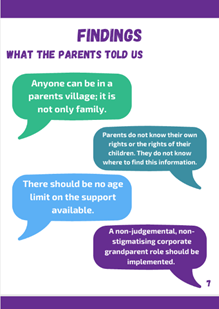
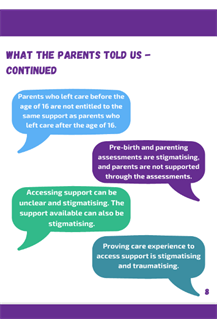
The vision to make the feedback as accessible and visually appealing as possible was one of trial and error. I had the idea of speech bubbles from very early on as I feel simplicity is often a strong way to go. Getting them right was another story entirely. The different font sizes annoyed me for a long time before I finally accepted it. It still feels the boldest statement and best way to communicate what we heard. Ultimately the importance is the words and having them as easy to see as possible. I had tried the colour blocks that ended up being used in the following pages of the charter (pages 11 and 12) which I loved but didn’t feel right for the feedback.
One of the biggest challenges we faced was getting parents to feel comfortable talking to us. It seemed like we had a lot of interest however when it came to the sessions, we heard that many parents were actually scared to even attend such an event, for fear of ‘stirring the pot’ and the perceived risk of losing it all when they are settled and living a quiet life with their children. The perceived risk caused a genuine fear of losing their children and this was continuously communicated with us throughout this research and a handful of birth parents spoke to us sharing that they only felt comfortable raising issues because they had already lost their children. An incredibly sad reality. In my opinion, this fear comes from how parents are treated and how they see their peers within the community treated. All the way from the booking appointment to the birth and to the continued parenting assessments that many parents are hit with, which has been described as jumping through hoops time after time, parents with care experience are treated as a risk to their children. Again, a terribly sad reality that many parents face due to their past experiences or simply the label of being care experienced. Care experience alone should not trigger the same pre-birth assessment processes used for serious safeguarding concerns. Parents described these assessments as discriminatory, traumatic and insensitive, highlighting the urgent need for change.

The Recommendations
There are seven recommendations that came out of this research and I am here to expand on them individually.
“Corporate parents must take on a corporate grandparent role where additional support or advice is required. This should look like practical support or emotional support.”
Recommendation one introduces the concept of a corporate grandparent. This was discussed in every session that we held (parent and professional), without the prompting beforehand. The definition of a corporate parent is “the formal and local partnerships between all services responsible for working together to meet the needs of looked after children, young people and care leavers” (The Children and Young People (Scotland) Act 2014) and the Scottish government goes on to state that “A good corporate parent will want the best outcomes for their looked after children, accept responsibility for them, and make their needs a priority.”. We heard that many care experienced parents do not have parents that they can rely on for things such as childcare, financial support, moral guidance, advice relating to medical queries or even down to schooling decisions. Care experienced parents that do have a parental figure in their life told us that they often do not feel comfortable asking their parent for this type of support. In these sessions we discussed why they think a corporate grandparent is needed and what one may look like and we heard that if you have a good parent then they would be involved in the upbringing and lives of their grandchildren, so why should our corporate parents not take that additional step to ensure the children of their ‘children’ have their needs met. I honestly could not agree more and believe that every parent needs someone to trust for advice and decision making support to get it right for their children. It is absolutely vital to add that this should only be where it is welcomed. Not every care experienced parent will want this, but they should be able to access the support that they want, at the time they want it. After all if someone called up their parent with a random question, more often than not they will receive an answer.
“Age must not be a barrier to support.”
Although self-explanatory, recommendation two was also unanimous amongst parents and professionals. This was not surprising, given the prominence of the lifelong rights campaign led by Who Cares? Scotland, however what we also considered in these conversations is actually that people are often choosing career paths, buying houses and waiting until they are older to have children; according to Parenting Across Scotland 30-34 is the most common age group. When typical aftercare supports go up to the 26th birthday, what use is extending that same support to parents when actually they had no intentions of having children at that point in their life, and even many years after. We heard that once you hit 26 care experienced people are left to fend for themselves. This would make a stronger argument for no age limit when accessing support services if required. My view on this is that if a care experienced parent requires support then they should be able to access it, regardless of their age.
“The pre-birth and parenting assessments must be reviewed with input from care experienced parents. This must involve consultations with those who have experienced these types of assessments to support with all reviews and any changes.”
I feel strongly about this recommendation. Simply being care experienced is enough to trigger a pre-birth assessment which can result in your baby being removed at birth, before you have even had an hour to prove your parenting skills. This is said to be a last resort, however there is a real fear amongst the care experienced community that when they have children of their own that social work will automatically be involved or the child be removed. This is enough for some people to reconsider if they want children or not. When exploring the statistics, I found a Scottish Government commisioned research piece about children born into care. The family circumstances around removal found that “Over a third of mothers (37%) and a quarter of fathers (24%) were care experienced.” As alarming as those numbers are, I would argue that these numbers could be higher as many people in informal kinship care or being looked after at home may not consider themselves to be care experienced, or may have never heard of the term. It is important that these assessments are not performed solely because of a parent being care experienced. Other factors must be considered; substance misuse, previous harm or removal of children etc. When a care experienced parent does meet adapted requirements for these assessments then they must be kept informed and included, be respected and supported throughout the assessments. One parent told us of how they were left in the dark for 12 weeks and had to ask about the assessment as they weren’t told the outcome. This recommendation asks that the care experienced community are included when these assessments are being reviewed.
“With permission from parents, services must work together to ensure information is only shared once where possible. This requires better communication between services and the parent(s).”
Recommendation four may appear as legally controversial, and this one probably took the most revamping to get it right. I will stand by it, however, as it is an important one. Parents told us of the trauma they feel when having to share their story time and time again, and this is well known across the care experienced community. Although data protection laws are important, having the option that allows parents to truly be in control of their story is ultimately where this recommendation comes in. When parents are working with a wide range of services, we heard parents tell us of an ideal world where services were allowed to communicate and share chosen information with one another. I imagine this as a universal system (I am not a software developer and my visions are far from what any final product may look like) where parents telling their story for the first time are allowed to contribute to what information can be shared with other services. They would have access to this information and be able to request changes at any point. It truly is a hard one to nail, however one that with some work I believe it can be done well.
“Appointments must accommodate children attending with parents. This may look like offering later appointments to allow for travelling with an infant or working around childcare.”
Another recommendation that, to me, feels like common sense. Recommendation five calls for leniency, allowing children to attend appointments with parents. Most NHS scans state that children are not permitted to attend, and I have personally seen people turned away if they had children with them. We heard during every parent session that finding childcare for these appointments is very difficult and unaffordable, or that appointments are very early in the morning when public transport may not be available or clashing with school/nursery drop offs. Care experienced parents are less likely to have reliable family support to support with these appointments and scans (this does not make them any less capable of parenting, simply stuck.). This call would work best when communicating with the parent, finding out what times work for them. Even better would see allocated staff available for appointments to watch children during appointment times, however this may just be a dreamland!
“More training in the workplace is needed to ensure that each member of staff is aware of what being care experienced means and what The Promise is. Knowing what support is available for care experienced parents will make signposting easier.”
Similar to work currently being done in North Lanarkshire with their virtual schools developing the Keeping the Promise Award, recommendation six demands more visibility and training to help reduce stigma. This means anyone who may work with or encounter care experienced parents would know what this means and have, at least, a basic level of knowledge and understanding. They would be able to signpost accurately and public perception would hopefully start to make a positive shift. In an ideal world, it would be great to see receptionists and even cleaning staff and porters (similar to how the keeping the promise award ensures that anyone employed in a school is required to undergo the training for the award to be granted) undergo a basic level of awareness training. We heard from many parents that they are often questioned on what care experience is, asked if it means they care for a parent and some even told us that they were asked why this should entitle them to “special treatment”. I think this point is pivotal in the reduction of stigma, because once people realise that care experience doesn’t mean you’ve done something bad or caued it on yourself then the public perception will shift.
“An identified contact clearly listed, and kept up to date, on council websites who can signpost any care experienced person to the right place at the right time.”
A reasonably straight forward ask that requires updated websites. The seventh recommendation requests that there is an allocated person that any care experienced parent can contact with a ‘no wrong door’ approach. According to the Scottish Government “This means that individuals are never turned away, or passed from service to service”. Parents told us that they often did not know their rights, the rights of their children or even where to find this information. This sparked discussion that having one allocated contact in an easy to find location would help parents be signposted to the right place at the right time. Professionals raised that often there are high staff turnovers so it would be important that this contact is kept up to date regularly so that no parent is left without someone to reach out to.
My Hopes
My hopes for the charter are that care experienced parents can live in a world where there is no discrimination or stigma, where they feel supported in a way that meets their needs. That they are included in decisions that affect them and their children. I hope that care experienced parents can be viewed for who they are now, and not who they were in their past. People grow and change, and parenthood can be the positive event that changes a person’s life for the better. Children are a blessing, support parents to raise them, let them love them and help families thrive.
 THE NATIONAL LEADERSHIP NETWORK
Leave a comment